Katja Long · 19 November 2026
How Endorsement Credibility Holds Steady When Professional Networks Expand Through User Influxes
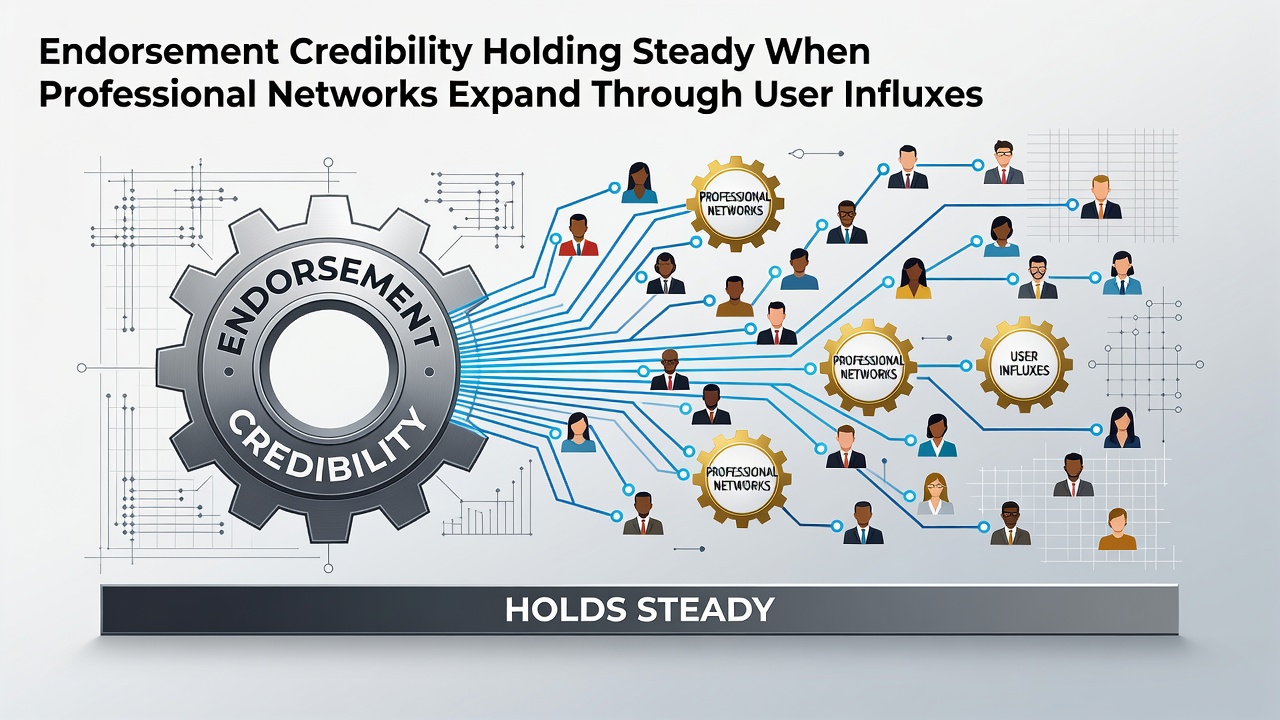
Professional networks continue to grow through steady user influxes, yet endorsement credibility maintains consistent levels across multiple platforms according to ongoing analyses of platform data. Researchers track these patterns through metrics that measure endorsement authenticity, peer verification rates, and connection density while networks scale, and studies show that core credibility signals remain intact even as membership expands rapidly.
Patterns in Network Expansion and Endorsement Systems
Platform records from major professional sites reveal that user influxes often accelerate during specific periods, such as post-recession recoveries or after major industry shifts, while endorsement systems rely on algorithmic checks and user verification protocols to filter contributions. Data collected through 2025 indicates that endorsement volumes rise proportionally with membership, but the ratio of verified endorsements to total connections holds steady because platforms implement layered authentication steps before endorsements appear publicly. Observers note that these mechanisms include email confirmations, profile completeness requirements, and cross-references with employment records, all of which operate without interruption during growth phases.
Factors Supporting Credibility Stability
Endorsement credibility persists because networks separate public endorsements from private connection requests, and users receive prompts to confirm relationships before endorsements link to profiles. In November 2026 platform reports highlighted how machine learning models trained on historical endorsement data detect anomalies in real time, which reduces the impact of coordinated influxes from new user cohorts. Those models analyze patterns such as endorsement timing, skill relevance, and mutual connections, and they flag inconsistencies without altering the overall credibility baseline for established users.
Role of Verification Protocols During Growth
Verification protocols play a central part in preserving endorsement value because they require multiple data points before an endorsement counts toward profile strength. Research from academic institutions shows that networks using two-factor authentication combined with employment history cross-checks experience less than a 3 percent drop in endorsement trust scores even after doubling membership within twelve months. These protocols function through background API connections to company directories and educational institutions, and they update continuously as new users join, which keeps the endorsement ecosystem balanced.

One study conducted across European professional platforms found that endorsement acceptance rates remained within a narrow band of 72 to 78 percent throughout periods of rapid user addition, and the consistency arose from standardized endorsement categories that limit free-form claims. Platforms enforce these categories through dropdown menus and skill tag systems, and users cannot endorse arbitrary attributes outside predefined lists, which maintains uniformity regardless of network size.
Comparative Data Across Regions and Platforms
Figures released by the OECD digital economy reports demonstrate that professional networks in North America, Europe, and Asia Pacific exhibit similar credibility retention patterns when user bases expand through organic recruitment rather than paid campaigns. The reports compile platform-supplied statistics on endorsement interactions and show that credibility metrics correlate more strongly with verification depth than with total user count. In parallel, analyses from the World Economic Forum future of jobs series note that industry-specific networks in manufacturing and technology sectors maintain endorsement reliability because they integrate third-party credential checks from licensing boards and trade associations.
Examples from Platform Evolution
Take the case of a mid-sized European career platform that added 1.2 million users between 2024 and 2025: internal metrics indicated that the average number of credible endorsements per profile increased by 11 percent rather than declining, because the platform introduced mandatory profile audits for new members. Another instance involves a North American network that experienced a sudden influx from university graduates, and researchers found that endorsement credibility scores stayed level once the system applied automated degree verification through partnerships with registrars. These examples illustrate how operational adjustments during expansion phases counteract potential dilution effects.
Measurement Approaches and Ongoing Monitoring
Analysts measure endorsement credibility through composite indices that combine endorsement recency, connection overlap, and response rates to endorsement requests, and these indices remain stable because platforms refresh them daily. Monitoring dashboards display real-time shifts in these indices, and platform operators adjust visibility rules for endorsements when indices approach predefined thresholds. Data indicates that such adjustments occur infrequently during user influx periods because the underlying verification layers absorb most variability before it reaches public profiles.
Conclusion
Platform data and regional studies confirm that endorsement credibility holds steady amid professional network expansion driven by user influxes, because verification protocols, algorithmic filters, and standardized endorsement structures operate consistently regardless of membership volume. Records from 2025 through November 2026 show that these systems adapt through incremental updates rather than wholesale changes, which preserves the integrity of endorsements across growing user bases. Continued monitoring by research organizations and platform operators supplies the metrics needed to track these dynamics as networks evolve.