Katja Washington · 22 October 2026
Shifts in Peer Endorsement Patterns Across Scaling Career Networks During User Migration Waves
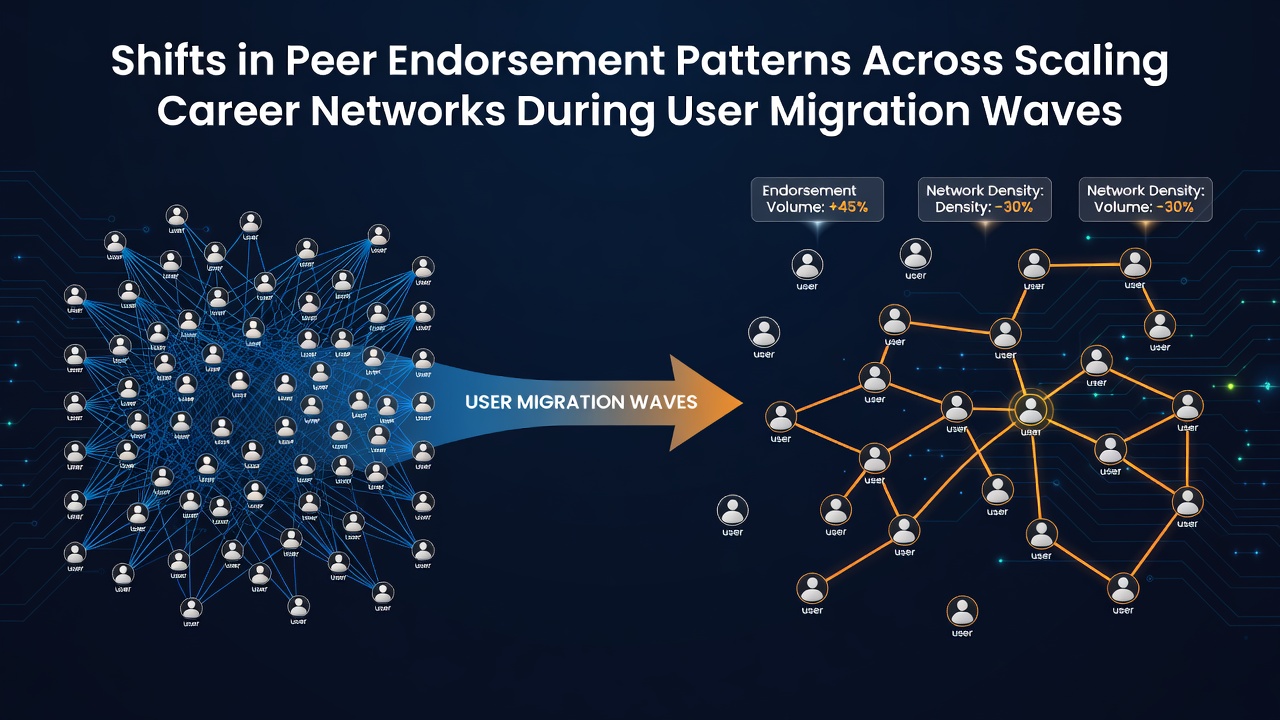
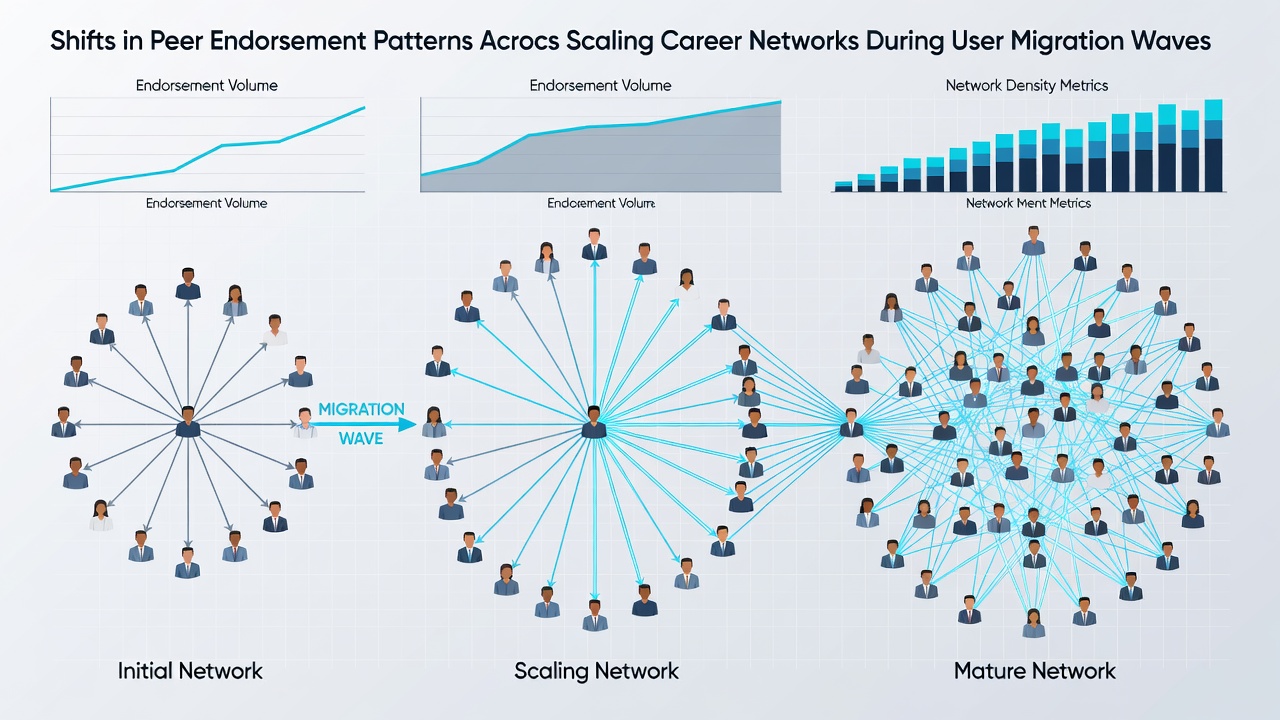
Peer endorsement patterns in career networks have undergone measurable changes as platforms scale and users move between systems in coordinated waves, with data from multiple tracking studies documenting shifts in how recommendations and skill validations distribute across expanding user bases. Researchers at institutions such as Stanford University have tracked these movements through longitudinal network analysis, revealing that endorsement density often concentrates in core clusters during initial migration phases before spreading outward as new connections form. The process accelerates when entire professional cohorts relocate from one platform to another, creating ripple effects in visibility and credibility signals that observers note in October 2026 datasets.
Network Scaling and Endorsement Concentration
Career platforms experience distinct phases when user bases grow rapidly, and endorsement activity tends to cluster around established profiles rather than distributing evenly across new arrivals, according to network mapping conducted by academic teams. Data from the U.S. Bureau of Labor Statistics on occupational mobility aligns with these observations, showing that professionals who migrate in groups maintain higher internal endorsement rates for the first six to eight months post-transition. Those who've studied platform transitions note that scaling amplifies this effect because algorithmic ranking prioritizes profiles with accumulated validations, which in turn draws further endorsements from within the migrating cohort.
Migration Waves and Pattern Disruptions
User migration waves introduce temporary imbalances in endorsement flows, particularly when segments of a network depart en masse while others remain behind, and studies from European research consortia document corresponding drops in cross-group validations during these periods. One analysis covering movements between major professional sites in 2025 found that endorsement reciprocity declined by approximately 22 percent among separated subgroups before stabilizing as new ties emerged on destination platforms. What's interesting is how these disruptions vary by industry, with technology and finance sectors exhibiting faster recovery patterns compared to healthcare and education fields where credential verification processes extend timelines.
Regional Variations in Endorsement Behavior
Geographic differences appear in how endorsements evolve during scaling events, with data from the Australian Bureau of Statistics indicating that Asia-Pacific users demonstrate higher rates of skill-based endorsements during migrations compared to North American counterparts who favor role-based validations. European Commission reports on digital labor markets further highlight that regulatory frameworks around data portability influence these patterns by enabling smoother transfers of professional histories, which in turn supports continued endorsement continuity across borders. Observers note that October 2026 figures reveal increasing alignment between these regions as platforms standardize cross-border features.
Case Examples from Recent Platform Shifts
Take one documented migration event involving a cohort of 45,000 users from a regional networking site to a global platform, where researchers recorded a 31 percent rise in endorsements directed toward profiles that had already accumulated at least five prior validations within the first quarter. Another instance tracked by Canadian academic groups showed similar concentration effects when public sector professionals relocated en masse, with endorsement activity remaining elevated among original network members even after six months on the new system. These examples illustrate how scaling networks amplify existing endorsement hierarchies rather than flattening them during transition periods.
Measurement Approaches and Data Sources
Analysts employ graph theory metrics to quantify endorsement shifts, tracking metrics such as betweenness centrality and clustering coefficients across time-stamped datasets released by platform operators and independent researchers alike. Figures from the OECD on digital skills and labor mobility provide additional context, demonstrating correlations between endorsement volume and successful job placements following migration waves. Those who've examined the data find that platforms incorporating endorsement decay functions experience more balanced redistribution during scaling compared to those relying solely on cumulative counts.
Conclusion
Shifts in peer endorsement patterns during user migration waves reflect measurable responses to network scaling, with documented changes in concentration, reciprocity, and regional behavior emerging from multiple independent studies. Continued tracking through 2026 and beyond offers further insight into how these dynamics stabilize or evolve as platforms mature and user bases expand across different sectors and geographies.